

A conversation with Jason Wickam, Vice President and General Manager at Sparro
Table of Contents
- What do you see as the trends that will most transform enterprise connectivity and network management heading into 2026?
- How are customer expectations changing across Sparro’s key verticals?
- How will automation and analytics evolve to improve reliability and performance?
- How do you see the balance between security and performance evolving?
- What role will partnerships and ecosystem collaboration play in next-generation connectivity?
- If you had to describe the 2026 enterprise connectivity landscape in one word, what would it be?
- What should enterprises be thinking about as they plan for 2026?
As enterprises continue to modernize their business operations, the demand for intelligent, adaptive, and high-performance connectivity solutions is growing rapidly. In 2026, private 5G and edge computing will converge, and AI will also play a larger role in improving networks. To support these trends, digital network infrastructure will be crucial.
To examine what is coming, we talked with Jason Wickam, Vice President and General Manager at Sparro. We spoke about technologies, trends, and changes in the industry shaping the next wave of enterprise connectivity. We also discussed how organizations can prepare for what lies ahead.
What do you see as the trends that will most transform enterprise connectivity and network management heading into 2026?
Wickam says that in 2026, enterprise networks will face greater demands. Applications will be more critical to business processes and less tolerant of disruptions.
He points to emerging use cases that demand extreme performance, reliability, and speed. Latency, jitter, and dropped connections simply aren’t acceptable. In these scenarios, traditional approaches such as Wi-Fi are no longer sufficient. Instead, high-performance licensed spectrum networks, private cellular, AI-driven routing, and hyper-performing edge computing are becoming essential.
Wickam described a large-scale professional racing series as one example of this shift. In that environment, there are dozens of fast-moving vehicles, plus safety systems that require connectivity. Public networks and thousands of spectators are present as well.
All these systems must work together in a crowded radio environment. This requires a carefully designed network that can seamlessly hand off connections, even at extreme speeds. These kinds of demanding, real-world applications demonstrate the near future of enterprise connectivity.
How are customer expectations changing across Sparro’s key verticals?
Even though 5G has matured, Wickam notes that many businesses still face challenges. They struggle to keep applications running when devices switch between networks.
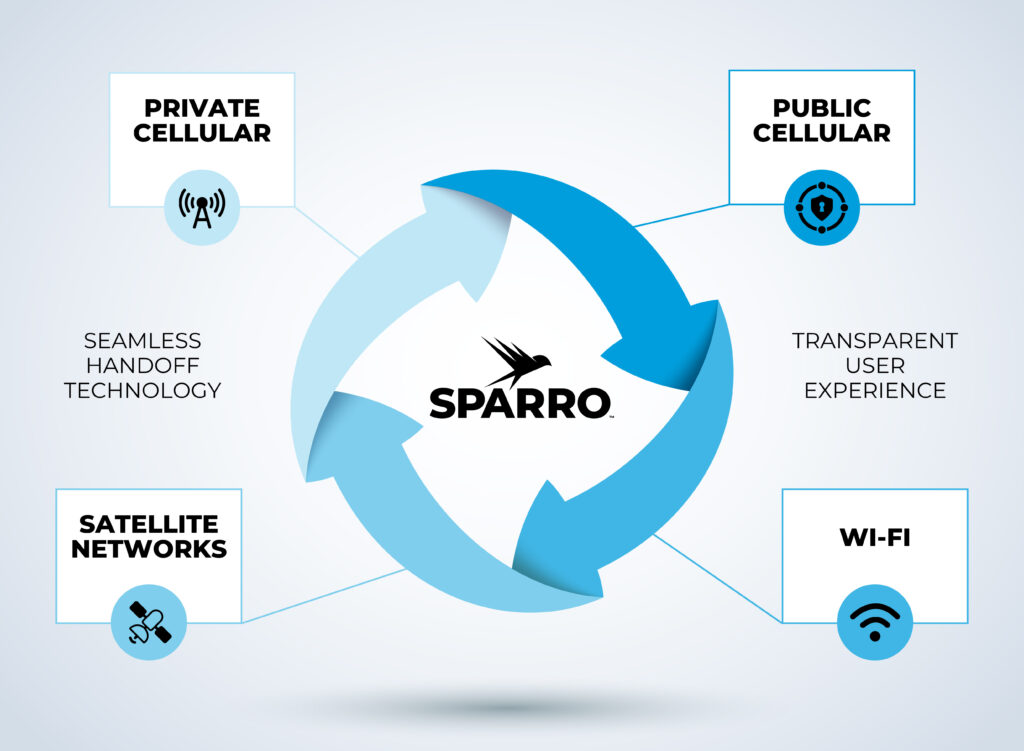
In industries such as logistics, manufacturing, aviation, healthcare, and warehousing, end-user devices often switch among different networks. These networks include private cellular, public cellular, Wi-Fi, and satellite. Too often, those transitions result in hard handoffs that break applications and force restarts, disrupting workflows and frustrating users.
As 2026 begins, expectations have changed. “Enterprises expect applications to keep performing without breaking, even as devices move from one network to another,” Wickam said.
Applications must remain available and performant, regardless of how or where a device connects. To bridge the gap between expectations and reality, enterprises need to break down barriers among different network types. They also need to implement a more unified and application-aware connectivity layer to support this.
How will automation and analytics evolve to improve reliability and performance?
Wickam believes the next several years will bring a major inflection point in how data and AI power automation. As analytics engines consume and evaluate larger volumes of network data, automation will move from reactive to predictive.
From 2026 through the end of the decade, he expects a significant increase in computing power. This “hockey stick” moment will allow for much smarter decision-making across networks. Analytics form the foundation of this intelligence, allowing automation to anticipate issues, optimize performance, and adapt in real time.
These advances will affect wireline networking and SD-WAN. However, Wickam believes the most significant changes will happen in wireless. Intelligent automation will greatly improve reliability, efficiency, and user experience in this area.
How do you see the balance between security and performance evolving?
As networks become more distributed and device counts continue to grow, security remains a constant concern.
Wickam explained that adding automation or new features can create new risks that IT teams need to address. He describes security as the “crown jewel” of enterprise infrastructure – essential, but constantly challenged by evolving threats.
Every new capability, from automation to advanced analytics, introduces potential new attack vectors. At the same time, threat actors are becoming more sophisticated, leveraging the same technological advancements to bypass traditional defenses.
Looking ahead, Wickam expects security architectures to add more layers of intelligence, authentication, and automated checks. While these measures may introduce complexity, they are necessary to protect increasingly critical and data-intensive environments. In short, security and performance must evolve together, with neither treated as an afterthought.
What role will partnerships and ecosystem collaboration play in next-generation connectivity?
No single vendor can solve today’s enterprise connectivity challenges alone. Wickam emphasizes that collaboration across technology partners is becoming essential to delivering effective, real-world solutions.
“Sparro is working on a strategic, ecosystem-driven approach,” said Wickam. This allows top partners to collaborate and test solutions across different settings. It also helps Sparro provide integrated services to businesses.
This model enables organizations to address complex operational gaps by aligning private cellular, advanced routing, and complementary technologies into cohesive solutions.
If you had to describe the 2026 enterprise connectivity landscape in one word, what would it be?
Wickam’s answer is simple: evolving.
“We’re focused on converging separate networks into a single plane. In this scenario, applications don’t even know they’re switching from network to network,” Wickam said.
Enterprises are increasingly focused on converging disparate networks into a single, cohesive ecosystem where applications perform consistently across access technologies. The goal is to create a connected environment in which applications switch networks seamlessly, without hiccups. Performance stays smooth, no matter where you are or how you connect.
As 2026 approaches, technological evolution is moving that vision closer to reality.
What should enterprises be thinking about as they plan for 2026?
As connectivity continues to evolve, enterprises need to rethink how they plan their networks. Teams can no longer treat connectivity as a fixed utility. It must adapt as applications, users, and networked devices change.
In 2026, applications will be more distributed and more demanding. Devices will move constantly across locations and network types. The network must support that movement without disruption. Planning for this future means designing connectivity for mobility, resilience, and scale from the start.
Wickam notes that many organizations still manage network technologies in silos. Private cellular, public networks, Wi-Fi, and edge infrastructure often operate independently. That approach creates performance and visibility gaps. It also increases operational risk.
Enterprises should focus on how these technologies work together. The goal is a coordinated system that supports applications first, not individual network components. When networks operate as a unified layer, applications can perform consistently, even as devices move.
This shift also requires a change in mindset. Instead of adding new technologies one at a time, organizations need a clear connectivity strategy. That strategy should align network decisions with business goals, application needs, and long-term growth. Enterprises that take this approach will be better prepared for what 2026 brings.
As enterprise connectivity evolves, organizations require partners who can design and deploy future-ready networks. Contact Sparro to see how the team is helping enterprises prepare with network optimization for 2026 and beyond.