

Table of Contents
- Three Ways to Operate Private 5G
- Private 5G Operating Model Decision Framework
- Start With Your Operating Environment
- Consider the Full Cost of Operating Private 5G
- Decide What Your Team Should Own
- Keep Private 5G Connected to the Broader Network
- Private 5G Within the Enterprise Connectivity Environment
- Don't Overlook IT/OT Ownership
- When Does Each Model Make Sense?
- Define Responsibilities Before You Sign the Contract
- Private 5G Doesn't Have to Be an All-or-Nothing Decision
- Need Help Defining Your Private 5G Operating Model?
We’ve often discussed the benefits of adding private 5G to enterprise networking strategies. However, deploying a private 5G network is only the beginning.
Once the network is live, someone needs to operate it. That means monitoring performance, managing users and devices, addressing issues, maintaining infrastructure, and planning for future growth.
For some enterprises, those responsibilities belong entirely in-house. Others may benefit from a managed services partner. A co-managed approach can divide responsibilities between internal teams and an outside provider.
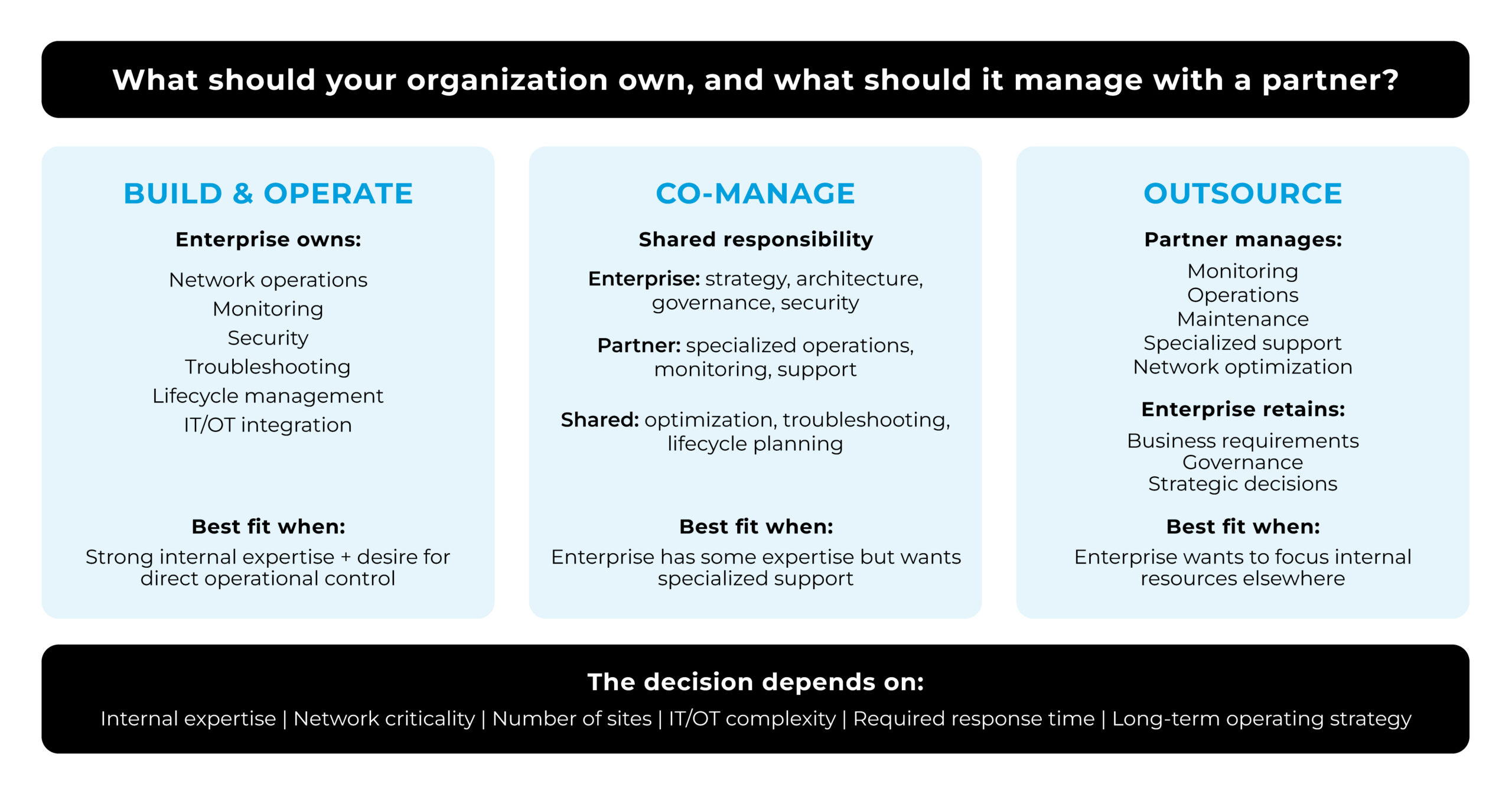
There is no single operating model that fits every organization. The better question is: What should your organization own, and what should it manage with a partner?
That decision should start with the business, operational, and technical requirements of the environment.
Three Ways to Operate Private 5G
Enterprises generally have three options for managing a private 5G environment: build and operate it internally, outsource operations, or co-manage the network with a partner.
Build and Operate
With an internal model, the enterprise takes responsibility for network operations. Internal teams manage monitoring, security, troubleshooting, maintenance, integrations, and lifecycle planning. This approach provides direct control over network policies and operations.
It also requires the right expertise and capacity.
Private 5G brings cellular technologies and operational requirements that may differ from an organization’s existing networking environment. Enterprises need to consider whether their teams have the skills and resources to manage those responsibilities over time.
Outsource
An enterprise can also work with a managed services provider to handle some or most network operations.
A provider may take responsibility for network monitoring, maintenance, troubleshooting, optimization, and other specialized functions. This can reduce the day-to-day operational burden on internal teams.
However, outsourcing does not eliminate the need for enterprise ownership.
The organization still needs to define business requirements, security expectations, governance, and strategic priorities. It also needs visibility into network performance and a clear understanding of what the provider manages.
Co-Manage
A co-managed model divides responsibilities between the enterprise and an external partner.
For example, an enterprise might retain ownership of architecture, security policy, IT/OT strategy, and governance. A partner might handle monitoring, specialized troubleshooting, network optimization, and routine maintenance.
The division does not have to be 50/50.
Jason Wickam, Vice President and General Manager at Sparro, describes several possible levels of support. “We can manage for them, or we can train or mentor their IT team. We can fully manage, co-manage, or provide light management focused mostly on escalations. There are options.”
That flexibility matters because an enterprise’s needs can vary by site, use case, and internal capabilities.
Private 5G Operating Model Decision Framework
Start With Your Operating Environment
Choosing an operating model should not start with the question, “Should we outsource?” Start by looking at the environment the network will support.
What capabilities already exist internally?
An enterprise may already have a strong networking team. That does not necessarily mean it has all the expertise needed to operate a private cellular network.
Consider the skills available across cellular networking, network monitoring, security, IT/OT integration, device management, troubleshooting, spectrum management, and infrastructure lifecycle management.
Then consider capacity. A team may have the technical knowledge but lack the resources to monitor another critical network around the clock.
How critical is the network?
The operating model should also reflect what the network supports.
A private 5G network serving routine employee connectivity has different operational requirements from one supporting warehouse automation, mobile robotics, connected vehicles, or other business-critical applications.
Ask:
- What happens if connectivity goes down?
- How quickly does the organization need to identify an issue?
- How quickly must it resolve that issue?
- Does the network support revenue-generating operations?
- Does it support safety, automation, or other critical functions?
- What level of support is required outside normal business hours?
The more directly connectivity affects operations, the more important the operating model becomes.
How many sites will you manage?
A single deployment may be relatively straightforward to support. However, a multi-site environment creates additional requirements for consistency, monitoring, security, documentation, support, and lifecycle management.
As private 5G expands across facilities or use cases, enterprises also need repeatable processes. Standardized architecture and governance can make future deployments easier to manage.
That can change the balance between internal and external responsibilities over time.
Consider the Full Cost of Operating Private 5G
The business case for private 5G should account for more than the cost of deploying the network.
There are also ongoing operational requirements. These can include staffing, training, monitoring and management tools, maintenance, security, troubleshooting, lifecycle management, vendor management, network optimization, and future expansion.
Outsourcing changes how those costs are structured. It does not make the cost of operating the network disappear.
That distinction matters when comparing operating models. The goal isn’t simply to find the lowest operational cost. Rather, it is to determine which model provides the capabilities, responsiveness, control, and scalability the business requires.
For a broader look at the financial side of private 5G, see How to Measure the ROI of Private 5G in Logistics. This guide looks at total cost of ownership alongside operational and financial outcomes.
Decide What Your Team Should Own
This may be the most important question in the entire decision.
Instead of asking whether to outsource private 5G, ask which responsibilities are strategically important for the enterprise to retain.
Consider each area separately.
| Responsibility | Questions to consider |
|---|---|
| Strategy | Who decides where private 5G fits within the broader connectivity strategy? |
| Architecture | Who owns the overall IT/OT and network architecture? |
| Security | Who establishes security policies, access requirements, and governance? |
| Operations | Who monitors the network and responds to incidents? |
| Integration | Who connects private 5G to enterprise applications and OT systems? |
| Performance | Who tracks network performance and identifies emerging issues? |
| Lifecycle | Who manages upgrades, maintenance, and future expansion? |
| Governance | Who owns provider relationships, SLAs, escalation paths, and accountability? |
This approach can reveal that the choice doesn’t need to be all or nothing.
An enterprise might want to own its network strategy and security while relying on a partner for specialized operations. Another might have the internal expertise to handle day-to-day management but need outside support for architecture or expansion.
The operating model should reflect those needs.
Keep Private 5G Connected to the Broader Network
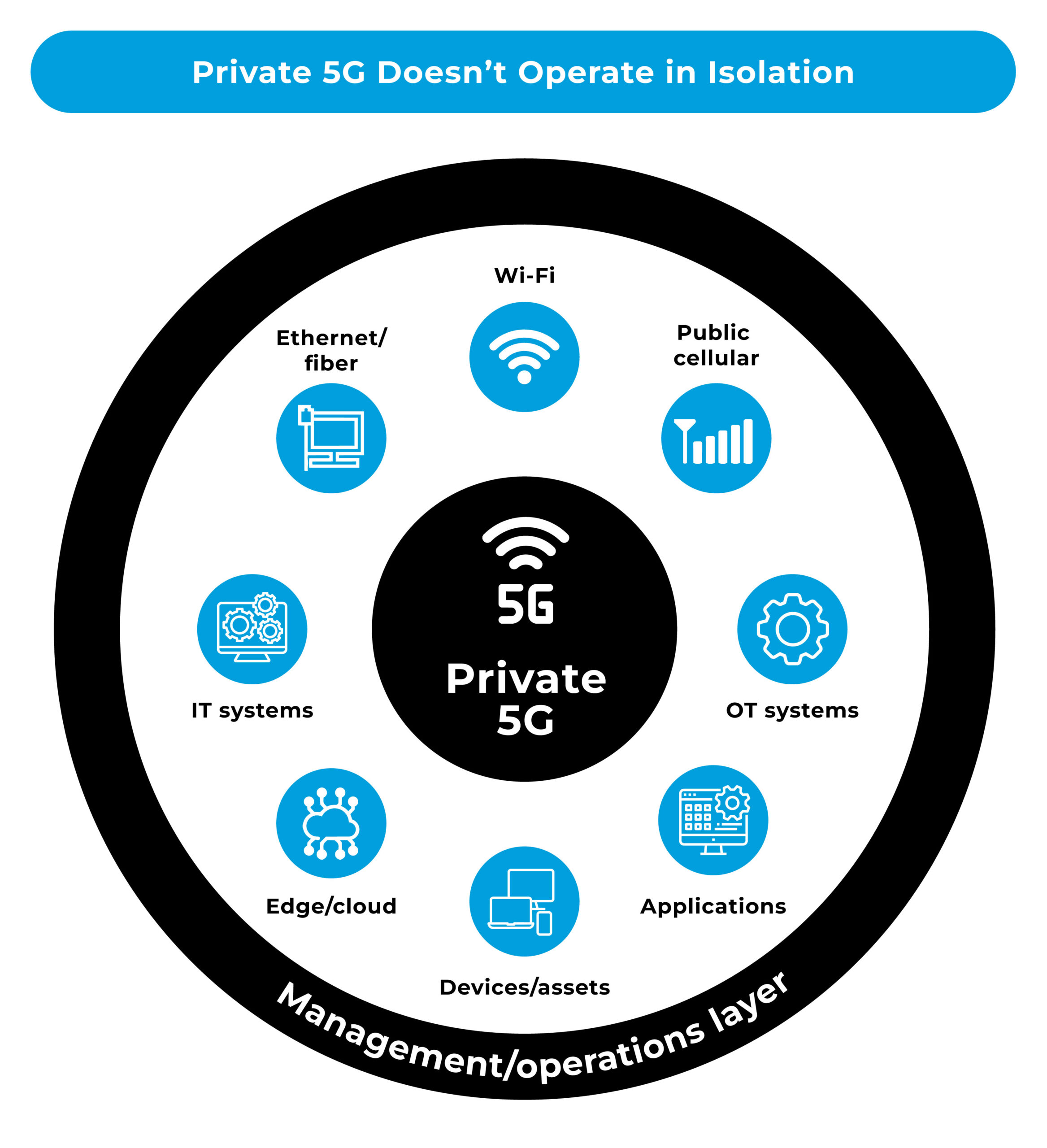
Private 5G should also be considered as part of the enterprise’s broader connectivity environment. It does not necessarily replace Wi-Fi, Ethernet, fiber, or public cellular networks. Each can serve different applications and environments.
Sparro’s Connecting the Dots: Integrating Private 5G with Enterprise IT/OT Networks explores how private 5G can fit into existing infrastructure and the considerations around architecture, integration, security, and governance.
Wickam makes the same point when discussing private 5G migrations. “One of the biggest misconceptions is that private 5G requires a complete replacement of existing infrastructure. In reality, the goal is to design a network that overlays and complements what’s already working, while delivering the performance today’s applications demand.”
That same principle applies to operations.
The enterprise doesn’t have to choose between completely internal management and handing everything to a third party. It can determine which parts of the connectivity environment need direct ownership and where specialized support makes sense.
Private 5G Within the Enterprise Connectivity Environment
Don’t Overlook IT/OT Ownership
Private 5G often sits at the intersection of information technology and operational technology. That can make ownership more complicated.
IT teams may focus on network architecture, security, scalability, and vendor management. OT teams may prioritize uptime, reliability, safety, and operational performance.
A private 5G operating model needs to account for both. That means defining who handles issues when a connectivity problem affects an operational application. It also means deciding who can make network changes, who owns security decisions, and who is responsible for escalation.
An operating model can look clear on paper but still create problems if those responsibilities remain unclear. Experienced integration and management partners can help bridge those gaps. However, the enterprise still needs clear internal ownership of the business requirements.
When Does Each Model Make Sense?
There is no universal answer, but several factors can point toward one model or another.
Build and operate may make sense when:
- The enterprise already has the required technical expertise.
- Network operations are a strategic internal capability.
- The organization wants direct operational control.
- Internal teams have the capacity to support the network.
- Private 5G fits closely with existing network operations.
Outsourcing may make sense when:
- The enterprise lacks specialized private 5G expertise.
- Internal teams need to focus on other IT or OT priorities.
- The network requires specialized monitoring and support.
- The organization wants a defined operational support model.
- The enterprise expects to manage multiple private 5G environments.
Co-management may make sense when:
- The enterprise wants to retain strategic control but needs additional expertise.
- Internal IT and OT teams have different responsibilities.
- The organization has some private 5G expertise but not enough for every operational function.
- The enterprise wants to retain architecture, governance, or security responsibilities while delegating specialized network operations.
These are not permanent choices, either. An organization could begin with more external support while its internal team develops expertise. It could bring certain responsibilities in-house later. It could also expand managed services as the deployment grows.
Define Responsibilities Before You Sign the Contract
Whatever operating model you choose, define responsibilities before deployment.
At a minimum, establish:
- Who owns each component?
- Who monitors the network?
- Who responds to incidents?
- Who has authority to make changes?
- Who manages security?
- Who handles upgrades and maintenance?
- Who measures network and application performance?
- Who handles issues that cross IT and OT boundaries?
- What does the provider manage?
- What remains the enterprise’s responsibility?
These questions can also help evaluate potential partners.
A provider should be able to explain not only what it manages, but how the enterprise maintains visibility and accountability.
That distinction is important. Outsourcing operational tasks should not mean outsourcing strategic ownership.
Private 5G Doesn’t Have to Be an All-or-Nothing Decision
Private 5G gives enterprises another connectivity option for applications that need specific levels of performance, reliability, mobility, security, or coverage.
However, deploying the network is only part of the decision. Enterprises also need an operating model that supports the network over time.
For some organizations, that means building internal capabilities. For others, it may mean outsourcing specialized operations. A co-managed model offers another option, allowing the enterprise to retain strategic responsibilities while bringing in outside expertise where needed.
The right choice depends on the environment.
Start with the business requirements. Evaluate the operational demands. Understand your internal capabilities. Then decide which responsibilities your organization should own and where a partner can add value.
As Wickam puts it, “Application requirements aren’t standing still. Every year they demand more from the network. Building resilient connectivity today gives organizations the foundation they need to support tomorrow’s applications.”
The operating model should be built with that future in mind.
Need Help Defining Your Private 5G Operating Model?
The right private 5G strategy involves more than selecting technology. It also means determining how the network will be deployed, managed, monitored, and supported over time.
Sparro can help enterprises evaluate their connectivity requirements, existing capabilities, and operational needs to determine what they should own and where outside expertise can add value.
Sparro’s private 5G offering includes professional and managed services such as remote monitoring, user management, deployment, and a customer portal.
Learn more about Sparro’s private 5G solutions and explore what the right operating model could look like for your organization.