

Table of Contents
- Start with the Workload, Not the Technology
- Give Ethernet, Wi-Fi, and Private 5G Defined Roles
- Design the Technologies as One Architecture
- What a Hybrid Network Can Look Like in Practice
- Coordinate Connectivity Around Application Needs
- Build in Security, Resilience, and Operational Readiness
- A Practical Process for Hybrid Network Design
- The Right Hybrid Network Starts With the Right Questions
Modern enterprise networks must support more devices, greater mobility, and increasingly demanding applications. In logistics, transportation, and industrial environments, connectivity serves everything from fixed equipment and office users to mobile robots, connected vehicles, and real-time operational systems.
No single network technology is right for every workload. Wired Ethernet offers dependable connectivity for fixed systems. Wi-Fi supports many everyday enterprise devices and applications. Private 5G can extend managed wireless connectivity to mobile assets and environments with specialized requirements.
Note that public cellular, satellite, and other options may also play a role. However, this discussion does not address those additional technologies.
The challenge is designing these technologies to work together. Rather than asking which network should win, enterprise technology leaders should ask what each workload needs. They must determine which technology best meets those requirements and how the resulting systems will operate as one environment.
Start with the Workload, Not the Technology
Hybrid network design should begin with an understanding of business operations and application requirements. Choosing technologies before evaluating those needs can create unnecessary complexity, coverage gaps, or infrastructure that fails to support long-term plans.
Start by identifying the workloads the network must support. Consider the following questions:
- Mobility – Does the application serve a stationary device, a worker moving through a facility, or equipment operating across a large outdoor area?
- Performance – What bandwidth, latency, and consistency does the application require? Are occasional interruptions tolerable, or could they disrupt an essential operation?
- Coverage – Does the workload operate in an office, across a warehouse, outdoors, or between multiple locations?
- Reliability – What happens when connectivity degrades or disappears? Does the application need a redundant connection or a defined recovery process?
- Security – Which devices, users, and applications need access? How should teams segment and control traffic?
- Manageability – Can the organization monitor performance, troubleshoot problems, and maintain connections across the relevant environment?
- Cost – What are the initial deployment costs, ongoing operating expenses, and resources required to manage the solution?
These requirements may vary by organization and even between applications at the same facility. A warehouse management terminal, an autonomous mobile robot, and a fixed industrial controller may operate in the same building but have different connectivity needs. The right network design balances these needs to provide connectivity that meets the application’s specific requirements.
Give Ethernet, Wi-Fi, and Private 5G Defined Roles
Once workloads and requirements are clear, organizations can assign each technology a role within the larger architecture. The following distinctions provide a starting point, not rigid rules. Actual performance depends on implementation, environmental conditions, device support, and application design.
Wired Ethernet: A Foundation for Fixed Systems
Wired Ethernet remains a practical choice for fixed equipment and infrastructure that benefits from a physical connection. Depending on the environment, this can include servers, network infrastructure, stationary industrial equipment, and other systems where cabling is feasible.
A wired connection can offer predictable performance. It also avoids the radio-frequency interference and shared wireless airtime associated with Wi-Fi. However, a wired system’s reliability still depends on its design, equipment, cabling, configuration, and redundancy.
Ethernet also requires physical infrastructure. Connecting equipment that moves around a facility may be impractical. Extending cabling to new locations can also limit flexibility or increase installation effort.
Consider Ethernet when: Equipment is stationary, a physical connection is practical, and the application benefits from stable, well-managed network access.
Wi-Fi: Flexible Connectivity for Users and Devices
Wi-Fi supports a broad range of enterprise applications, including laptops, tablets, handheld scanners, and many connected devices. It works well in offices, warehouses, retail spaces, and other environments where users and devices need wireless access within a defined coverage area.
However, Wi-Fi performance depends on access point placement, building materials, interference, client density, roaming behavior, and available airtime. A network designed primarily for office use may not automatically support a high density of operational devices or demanding mobility requirements.
Planning should reflect how devices move, where coverage is needed, and how applications behave when users roam between access points. Device compatibility and the ability to monitor and troubleshoot the wireless environment also matter.
Consider Wi-Fi when: Applications need flexible local wireless access, devices are compatible with the network, and a well-designed deployment can meet coverage and performance requirements.
Private 5G: Managed Wireless Connectivity for Specific Operational Needs
Private 5G can be valuable when organizations need wireless connectivity for mobile assets, connected equipment, or operations with specialized coverage and performance requirements. Potential use cases include mobile robots, connected vehicles, industrial IoT devices, and applications that benefit from a managed cellular network.
Depending on the deployment, private 5G may offer advantages in mobility management, coverage planning, and support for connected devices across operational areas. Its suitability still depends on spectrum availability, radio design, device compatibility, application requirements, security, and total cost of ownership.
Private 5G is not automatically faster, more reliable, or less expensive than Wi-Fi. Nor does it eliminate the need for Ethernet. In many environments, the strongest design combines all three technologies.
The GSMA’s guidance on industrial IoT connectivity reinforces this workload-first approach. Ethernet, Wi-Fi, and gateways remain important parts of industrial infrastructure. Cellular connectivity can also serve mobile assets, broader coverage requirements, and changing operational environments. The appropriate mix depends on the facility, existing systems, and business priorities.
As Jason Wickam, Vice President and General Manager at Sparro, explains, “Private cellular isn’t here to replace Wi-Fi. It’s the next evolution of enterprise connectivity, enabling the performance, reliability, and deterministic networking that AI, automation, and other high-performance applications increasingly require.”
The key is not to assume private 5G is automatically the better option for demanding applications. Instead, determine whether its capabilities address a specific requirement that existing connectivity cannot adequately meet. That assessment should also account for the application, device capabilities, network design, and deployment environment.
Consider private 5G when: Specific mobility, coverage, management, or operational requirements justify it and the business case supports the deployment.
Design the Technologies as One Architecture
Selecting the right connection for each workload is only part of the challenge. Organizations must also plan how those connections will integrate with applications, infrastructure, security controls, and day-to-day network operations.
A hybrid network should not become three separate technology projects that happen to coexist. The design must account for how traffic moves between devices, applications, edge systems, data centers, and cloud services.
Several considerations can help bring the architecture together:
- Define security boundaries. Establish which devices and users can communicate, which applications they can access, and how teams should segment traffic. Each network technology has its own configuration and management considerations. However, security policies should support a coherent enterprise strategy.
- Plan traffic management. Different applications have different priorities. Real-time operational traffic, business applications, video, and general user activity may need different treatment. Understand where traffic enters and leaves each network, how it reaches its destination, and which controls can prioritize or restrict it.
- Establish visibility across the environment. Teams need enough monitoring and diagnostic information to identify whether a problem originates with a wireless connection, wired infrastructure, an application, or another dependency. Without clear visibility, troubleshooting can become a series of disconnected investigations.
- Account for integration and ownership. Define who manages each part of the environment, how teams escalate incidents, and how they test changes. Make shared responsibilities between network, security, operational technology, and application teams explicit.
As Wickam puts it, “Infrastructure conversations happen at the beginning of an enterprise technology journey. When you’re involved early, you can help shape the architecture instead of simply reacting to decisions that have already been made.”
That principle matters when designing a hybrid network. Connectivity choices can affect device procurement, application deployment, security architecture, facility design, and future expansion. Bringing these decisions together early helps teams identify dependencies and avoid expensive rework.
It also encourages organizations to evaluate the complete solution rather than choose individual technologies in isolation.
What a Hybrid Network Can Look Like in Practice
The right combination will vary by environment. These examples illustrate how organizations might allocate workloads across technologies. They are not universal deployment prescriptions.
Distribution and Logistics Facilities
A distribution center may use Wi-Fi for handheld scanners and employee devices, Ethernet for fixed infrastructure, and private 5G for selected mobile assets or applications with specific coverage and mobility requirements.
The important step is to map actual operations. A mobile robot may have different needs from a handheld scanner, even if both move through the same aisles. Before selecting a network, assess device support, movement patterns, coverage, traffic demands, and the consequences of a connection failure.
Manufacturing and Industrial Operations
A manufacturing facility may rely on Ethernet for fixed equipment and established industrial systems, Wi-Fi for suitable user devices, and private 5G for selected mobile equipment or use cases that benefit from wireless flexibility.
Integration deserves particular attention in these environments. Existing industrial systems may have specific communication, timing, or availability requirements. A new wireless network must fit those requirements rather than assume all traffic can move onto a single platform.
Transportation and Outdoor Operations
Transportation yards, terminals, and other outdoor operations may combine wired connections at fixed locations with Wi-Fi for localized access and private 5G for selected mobile assets or broader operational coverage.
The design should account for how equipment moves across the site, where coverage is required, and how connectivity supports the systems coordinating those operations. A network that works well in one area may not provide sufficient coverage or performance throughout the entire operating environment.
Across all three examples, the same principle applies: choose connectivity based on the workload, then design the connections and supporting systems to work together.
Coordinate Connectivity Around Application Needs
Even when each technology has an appropriate role, network conditions can change. Wireless coverage, congestion, signal quality, and connection availability may affect application performance. Organizations should consider how traffic will move when a preferred connection degrades or becomes unavailable.
Intelligent traffic management can complement a broader connectivity strategy.
Sparro ARC (Adaptive Route Control) provides one example. It can automatically route traffic over available 4G/5G LTE or Wi-Fi connections based on network quality and availability. Application-based policies can help determine which connections are appropriate for different types of traffic.
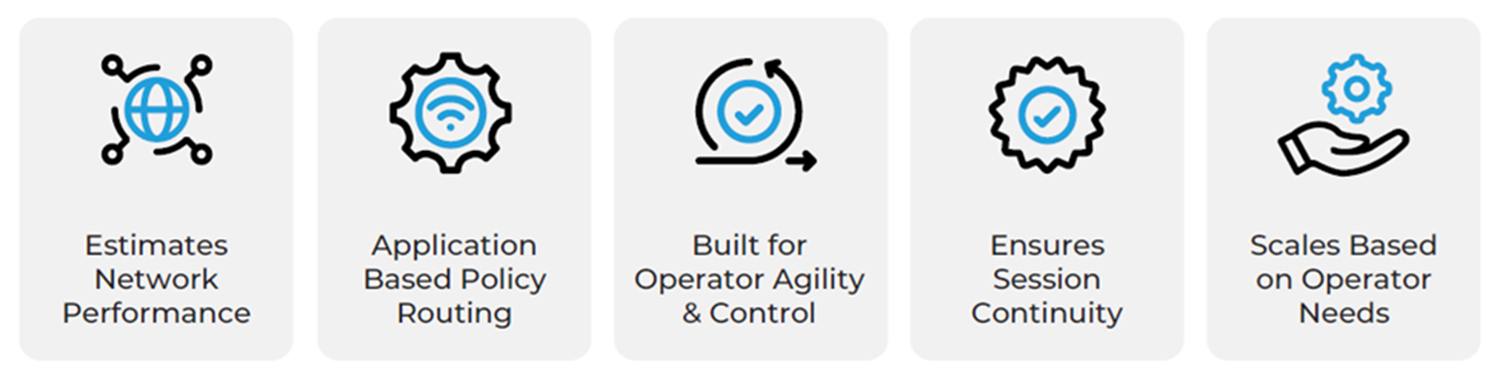
ARC addresses a specific part of the connectivity challenge: managing traffic across supported wireless connections. It does not replace the need to design the underlying network architecture, establish security policies, or manage wired infrastructure. Rather, it illustrates how intelligent routing can complement a hybrid connectivity strategy.
Organizations should also define what happens when a connection fails. Automatic traffic steering is not a substitute for a complete failover plan. Evaluate application behavior, session continuity, recovery time, and the availability of alternative connections against operational requirements.
The goal is to make connectivity decisions reflect application needs and changing network conditions. Organizations should not rely on a single connection to perform equally well in every situation.
Build in Security, Resilience, and Operational Readiness
A hybrid architecture introduces flexibility, but it also creates more design and management decisions. Each technology needs appropriate security controls, monitoring, and support. Those controls must work together. Connecting multiple networks does not automatically create redundancy or resilience.
Before deployment, teams should consider:
- Redundancy and recovery – Identify critical workloads, failure scenarios, and recovery requirements. Confirm whether alternative connections are available and whether applications can use them as intended.
- Segmentation and access – Define how devices, users, and applications are authenticated and authorized. Limit access according to operational needs.
- Monitoring and troubleshooting – Determine what performance data is available across each network and how teams will correlate issues.
- Change management – Establish how teams will test and document configuration changes, new devices, and application updates.
- Operational ownership – Assign responsibility for network performance, security incidents, and coordination between IT and operational technology teams.
Testing should reflect real conditions, not just a successful connection in a controlled demonstration. Validate coverage where devices operate, assess performance under realistic traffic loads, and test the scenarios that matter most to the business.
For industrial environments, integration between 5G wireless networks and existing Ethernet systems also deserves close attention. The 5G Alliance for Connected Industries and Automation (5G-ACIA) provides technical guidance on this subject in its paper, Integration of Industrial Ethernet Networks with 5G Networks.
A Practical Process for Hybrid Network Design
Enterprise leaders do not need to begin by selecting every component of a future network. A structured assessment can help establish priorities and reveal where different technologies may add value.
- Inventory applications and devices. Document what needs connectivity, where it operates, and how critical it is to business operations.
- Classify workload requirements. Assess mobility, performance, coverage, reliability, security, and manageability.
- Map workloads to technologies. Identify where Ethernet, Wi-Fi, private 5G, or a combination can meet each requirement.
- Design the integration points. Plan routing, segmentation, application access, monitoring, and connections to existing systems.
- Test the proposed architecture. Validate performance, coverage, security, and recovery under realistic conditions.
- Measure business outcomes. Evaluate results against the original operational goals, not simply whether the technology works.
- Expand based on evidence. Use the findings to prioritize further investment and refine the design as requirements evolve.
This approach helps organizations avoid deploying private 5G simply because it is available, expanding Wi-Fi without validating its suitability, or retaining wired infrastructure without assessing how it supports future operations. The objective is not to maximize the use of any single technology, but to create a connectivity environment that supports the business.
The Right Hybrid Network Starts With the Right Questions
Private 5G, Wi-Fi, and Ethernet each play a role in enterprise connectivity. The challenge is determining where each fits, how the technologies interact, and what the business needs from the combined environment.
That requires more than a technology comparison. It calls for an understanding of workloads, operational constraints, security requirements, existing infrastructure, and long-term plans. It also requires coordination between the teams responsible for applications, network infrastructure, security, and daily operations.
Sparro helps organizations assess connectivity requirements and plan network architectures around their operational needs. For teams evaluating private 5G alongside Wi-Fi and wired infrastructure, that work can clarify where each technology fits and how the pieces can support a coherent strategy.
Ready to evaluate your hybrid network strategy? Talk with Sparro about aligning connectivity technologies with your applications, operational requirements, and long-term business goals.