
Table of Contents
- How hospitals can use connected technology to improve safety, efficiency, and compliance
- IoMT Adoption and Trends
- The Benefits of IoMT in Healthcare Settings
- What IT Teams Should Know Before Deploying IoMT Solutions
- Examples of High-Impact IoMT Use Cases in Hospitals
- Introducing SmartSharps: Smarter Sharps Disposal Through IoMT
- Ready to Rethink Your Facility’s Sharps Disposal?
How hospitals can use connected technology to improve safety, efficiency, and compliance
The Internet of Medical Things (IoMT) continues to reshape how hospitals manage daily operations. From clinical diagnostics to operational workflows, connected medical devices are enabling hospitals to run more efficiently, safely, and effectively.
Many discussions focus on remote patient monitoring and wearable diagnostics. While most attention stays on clinical use cases, connected devices also play a growing role behind the scenes. For hospital leaders, these operational applications often deliver fast, measurable returns.
IoMT now supports everything from asset tracking to environmental monitoring. However, IoMT also has powerful applications in the everyday logistics of healthcare, including waste management.
Sparro implements technologies like IoMT to solve problems and improve operations in real-world settings. For example, disposal of used needles remains a daily operational burden for healthcare organizations. Sparro’s SmartSharps concept applies IoMT principles to this challenge, improving efficiency while reducing risk.
This article explores how IoMT supports hospital operations. We also discuss what IT teams should consider before deployment. Finally, we consider how a concept like SmartSharps can modernize sharps disposal with real-time visibility.
IoMT Adoption and Trends
IoMT refers to the growing ecosystem of connected medical and operational devices that transmit data across hospital networks. These devices collect, share, and sometimes analyze information in real time.
The result is better visibility across both clinical and non-clinical workflows. This leads to more informed decisions and more efficient resource use.
Analyst research, such as Deloitte’s, highlights IoMT as a key technology modernizing healthcare infrastructure. This is especially true as providers strive to meet growing demand with limited staff and resources.
Hospitals already rely on IoMT in many areas, including:
- Remote patient monitoring and wearables
- Connected diagnostic and imaging equipment
- Infusion pumps and respiratory devices
- Environmental sensors and facilities systems
- Operational tools that support logistics and waste management
Industry analysts project rapid growth in IoMT adoption across healthcare settings. Fortune Business Insights projects that the global IoMT market will reach USD 814.28 billion by 2032, with a 38.5% CAGR.
North America accounts for nearly a third of this market. In the US alone, analysts expect it to reach USD 167.04 billion by 2032. Much of this adoption comes from hospitals seeking efficiency gains amid staffing shortages and rising costs.
The Benefits of IoMT in Healthcare Settings
When deployed with purpose, IoMT delivers clear operational value. Hospital leadership often prioritizes use cases that reduce manual work while improving safety and compliance.
Key benefits include:
- Increased efficiency – Automating routine tasks frees up staff for higher-priority care.
- Better patient outcomes – Real-time data enables earlier interventions and more personalized care. This can also lead to higher HCAHPS scores.
- Improved visibility – Cloud-based reporting helps leadership monitor operations across departments or facilities.
- Cost savings – Reducing unnecessary labor, repeat procedures, or equipment usage adds up.
- Compliance and documentation – Digital logs simplify audits and support safety protocols.
But achieving these benefits requires more than just deploying new technologies; it takes careful planning.
What IT Teams Should Know Before Deploying IoMT Solutions
Before bringing any IoMT solution into a healthcare facility, IT leaders should plan for:
- Network infrastructure – IoMT devices add more endpoints and more data. Strong, secure wireless coverage and other digital infrastructure are critical.
- Cybersecurity – Each device requires secure connectivity, encrypted data transmission, and regular updates and patches.
- Interoperability – IoMT tools should integrate with existing EHR/EMR systems, databases, or facility management software.
- Staff training – Clinical and operational teams must understand how to interact with IoMT technology and why it is essential.
- Data collection strategy – Leadership must decide who has access to data and where teams will store it. They also need to determine how they will use that data to inform decisions.
Examples of High-Impact IoMT Use Cases in Hospitals
Hospitals are adopting IoMT solutions across clinical and operational workflows. Many of these deployments focus on visibility, automation, and risk reduction. The goal is simple: to improve care delivery while controlling cost and complexity.
Real-Time Asset Tracking
Connected asset-tracking systems help hospitals locate high-value equipment, such as infusion pumps, wheelchairs, and portable imaging devices. Sensors and tags transmit location data across the network in real time.
This reduces time spent searching for equipment and lowers unnecessary equipment purchases. It also improves utilization rates and supports preventive maintenance planning.
Remote Patient Monitoring
IoMT-enabled monitoring devices enable care teams to track patients’ vital signs both inside and outside the hospital. These systems transmit continuous data to clinical dashboards for review.
Earlier intervention becomes possible when thresholds are crossed. Hospitals can reduce readmissions, improve continuity of care, and expand access to services.
Environmental and Infection Control Monitoring
Connected environmental sensors track temperature, humidity, and air quality in critical areas. Some systems also monitor hand hygiene compliance and other infection control indicators.
Real-time alerts help facilities teams respond quickly to out-of-range conditions. This supports regulatory compliance and strengthens patient safety initiatives.
Introducing SmartSharps: Smarter Sharps Disposal Through IoMT
Sparro’s SmartSharps is an IoMT-based concept for healthcare waste management. This solution, currently in development, tracks and optimizes the collection of used needles (sharps).
In most hospitals today, staff must physically visit each sharps bin on a set schedule. This is the only way to determine whether a bin is overfull.
While this is the standard approach, it results in unnecessary trips and inefficient labor utilization. At times, it also leads to bins overflowing before staff notice and can empty them.

SmartSharps changes that. It uses a built-in sensor that shines a beam across the top of the bin.
When the sharps pile nears capacity, it blocks the beam. The device then automatically sends a notification to a central dashboard.
That way, staff only go to bins that are full and do so more promptly.
Why It Matters: Efficiency, Safety, and Transparency
SmartSharps is more than just a convenience feature. It helps solve real operational challenges:
- Fewer staff hours wasted on mostly empty bins.
- Reduced cleaning and turnaround for reusable containers.
- Lower equipment costs, since facilities need fewer extra containers and carts.
- Fewer patient interruptions, which can improve both care and HCAHPS scores.
- Improved tracking and accountability, with a cloud-based database of full-bin reports, timestamps, and staff actions. SmartSharps also offers the ability to create reports for leadership.
The solution is configurable across different types of bins and enclosures. Thus, it can adapt to your facility’s equipment and workflows. Because it reports to the cloud, it provides leadership with real-time insights across units and locations.
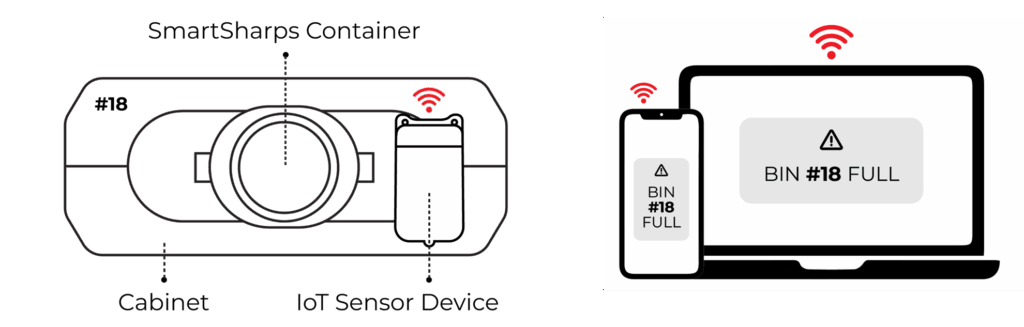
SmartSharps applies IoMT principles to a routine yet crucial aspect of healthcare operations.
The Bigger Picture: Practical Innovation That Drives Results
The SmartSharps concept is an example of practical, connected technology that makes an impact. It helps healthcare facilities transition to smarter, data-driven operations without requiring teams to overhaul everything at once. This innovation also delivers meaningful improvements in labor use, compliance, and patient experience.
Ready to Rethink Your Facility’s Sharps Disposal?
Sparro delivers purpose-built solutions to address operational challenges, from wireless infrastructure to smart solutions such as SmartSharps.
Are you ready to learn more about how IoMT can drive efficiency, reduce costs, and support staff? Visit gosparro.com today to discover how we can help.